

Electricians Who Hire the Right Marketing Agency Scale Faster—and Here’s What to Look For
I’ve watched two agencies burn through $18,000 of our budget before I learned what questions actually mattered.
The first promised page-one rankings in six weeks. The second delivered 147 “leads” in a month—turns out 89 were out-of-territory, 31 wanted free quotes on work we don’t do, and exactly four turned into booked jobs. When I moved in-house and started running our marketing operations, other electrical contractor owners started reaching out. They’d seen the YouTube threads where guys like us vent about lead-gen shops selling junk, hiding behind dashboards that show “impressions” but never explain why the phone isn’t ringing with real work.
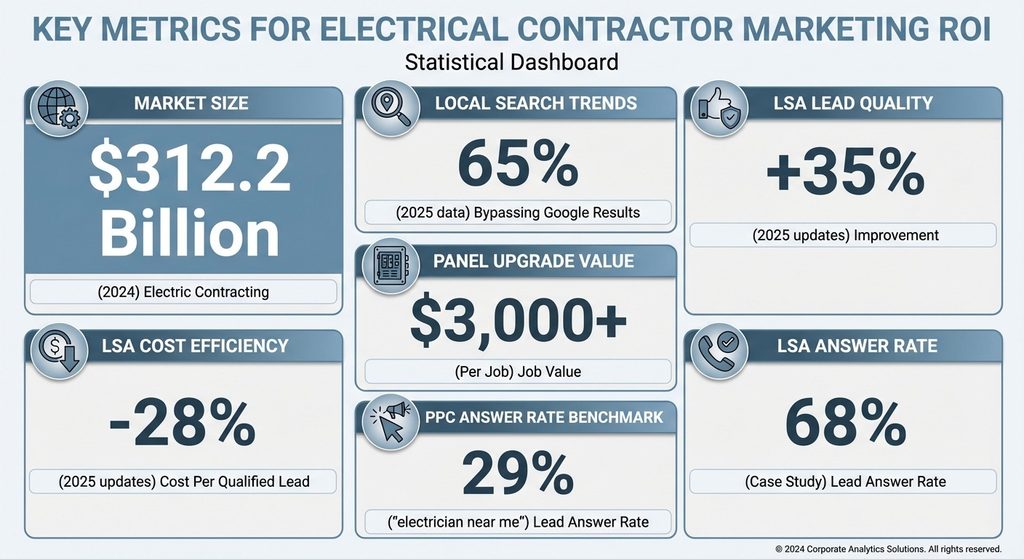
Now I help regional contractors vet agencies before they sign. What I’ve learned: the difference between wasting money and actually growing comes down to knowing what to verify, what to ignore, and which promises are smoke. The electrical contracting industry is projected to reach a valuation of $312.2 billion this year, which means more competitors are buying their way into your local search results and outranking shops that have been around for decades.
If you’re still relying on word-of-mouth and a static website, you’re losing ground every week.
Why Generic Digital Marketing Agencies Fail Electrical Contractors
Marketing isn’t marketing when you’re dealing with permit requirements, license jurisdictions, and sales cycles that stretch across weeks instead of hours.
I used to think any competent agency could handle our business. That assumption cost us six months and a lot of trust with our team when leads didn’t convert. The reality: electrical contracting has compliance layers and operational nuances that generic B2C agencies don’t understand. A homeowner searching “panel upgrade near me” isn’t the same as someone Googling “emergency outlet repair”—one is a $3,000+ job with permit coordination, the other might be a $150 service call.
If your agency doesn’t structure campaigns around job type, service area licensing, and whether you’re residential, commercial, or both, you’re paying for traffic that will never book.
The Dashboard Deception
Dashboards full of metrics don’t mean the agency is doing its job.
I’ve seen reports that highlighted 12,000 impressions and 340 clicks but buried the fact that our cost per lead had doubled and our close rate tanked. Impressions don’t pay your crew. What matters is whether the leads answer when you call back, whether they’re in your service territory, and whether the job is something you’re licensed and staffed to handle.
An agency that can’t or won’t show you those numbers is either inexperienced with trades businesses or hoping you won’t ask.
The Three-Pillar Framework: How to Evaluate Agencies Before You Sign
After firing two agencies and building our in-house system, I reverse-engineered what separated useful partners from expensive distractions.
| Pillar | What It Means | How to Verify |
|---|---|---|
| Trade-Specific Execution | Proven experience with electrical contractors, not generic home services | Request portfolio examples, review actual campaign structures, examine optimized Google Business Profiles |
| Transparent Performance Tracking | Direct access to platforms and weekly changelogs, not just monthly PDFs | Demand login credentials, insist on platform-level visibility, require detailed activity logs |
| Operational Integration | Understanding of your booking workflow, CRM, and follow-up process | Assess their questions about your operations, evaluate their lead scoring methodology, review their intake optimization approach |
Each pillar has verification steps you can run during the vetting process—not after you’ve signed a six-month contract.
Pillar One: Proof of Trade-Specific Execution
The agency has worked with electrical contractors before and can show you the actual work, not just case studies with scrubbed client names.
Ask to see a Google Business Profile they’ve optimized for an electrician—check the service area settings, the categories, the posts, and whether reviews mention the agency coached the owner on responding. Request a sample PPC account structure: are campaigns split by service type (panel upgrades, generator installs, EV charger work) or lumped into one “electrician services” campaign?
If they can’t walk you through these details in the sales call, they’re learning on your dime.
Pillar Two: Transparent Performance Tracking
You need access to the actual platforms—Google Ads, Google Analytics, your call tracking dashboard—so you can see what changed week over week.
Insist on a shared view of your accounts and a weekly or biweekly changelog: “We paused these three keywords, added this negative list, adjusted bids on mobile for service calls under $500.”
If an agency resists giving you login access or says their “proprietary dashboard” is all you need, walk away.
Pillar Three: Operational Integration
Your marketing doesn’t end when someone fills out a form or calls your number.
If your intake process is slow, your voicemail generic, or your follow-up inconsistent, even great leads will ghost you. A good agency will ask about your booking workflow, your CRM, and how fast your office returns calls. They should help you set up call recording and lead scoring so you can tell which campaigns are sending qualified prospects versus tire-kickers.
When I started tracking this for our shop, we discovered that leads from Local Service Ads had a 68% answer rate and a 41% booking rate, while leads from a broad “electrician near me” campaign had a 29% answer rate and a 12% booking rate. That insight let us reallocate budget toward what actually worked.
The agencies worth hiring treat this as a partnership. They’ll ask uncomfortable questions about your capacity, your pricing, and whether your Google Business Profile has been claimed and verified. They’ll want to know if you have photos of your trucks, your team, and finished jobs.
The Three Places Contractors Lose Money: Local SEO, PPC Structure, and Lead Quality
Local SEO: The Invisible Foundation
Recent search behavior data shows that 65% of electrical service searches now bypass traditional Google results entirely—they’re happening in the Local Pack (the map results at the top) or through Local Service Ads.
If your Google Business Profile isn’t fully optimized, you’re invisible to most of your market.
That means accurate service areas, the right primary category (Electrician, not “Contractor”), regular posts, and a steady stream of reviews. I’ve audited profiles where the agency claimed to be “managing local SEO” but hadn’t updated the business hours in eight months or left the service area set to a single ZIP code when the contractor covered three counties.
Google’s algorithm rewards active, accurate profiles. If your agency isn’t logging into your GBP weekly and making changes, they’re not doing local SEO.
PPC: Where Campaign Structure Determines Lead Quality
The quality of your leads depends entirely on campaign structure and negative keyword management.
I inherited a Google Ads account where 40% of our spend was going to searches like “how to wire a light switch” and “electrician salary in [city]”—zero commercial intent. A competent agency will build separate campaigns for high-intent service calls (emergency electrical repair, panel upgrade, generator installation) and use negative keywords to block informational and job-seeker queries.
Ask the agency to show you their negative keyword list and explain how they built it. If they don’t have one or it’s generic (“free,” “DIY,” “jobs”), they’re wasting your budget.
Lead Quality: The Ultimate Test
Industry practitioners report that Local Service Ads deliver 35% better lead quality and 28% lower cost per qualified lead after Google’s 2025 updates—but only if the profile is set up correctly and the agency is monitoring lead disputes and adjusting bids.
Your agency should be tracking lead disposition: how many answered, how many were qualified, how many booked, and how many closed. If they can’t show you that data, they’re not managing lead generation—they’re just turning on ads and hoping.
Five Questions That Expose Inexperienced Agencies
When you’re on a discovery call, ask these questions and watch how the agency responds.
1. “Can you show me a Google Business Profile you’ve optimized for an electrical contractor, and walk me through what you changed?”
If they can’t pull up an example or they show you a profile with outdated info, missing posts, or a single-ZIP service area, they don’t know local SEO.
2. “How do you structure PPC campaigns for electrical contractors, and what negative keywords do you use?”
Listen for specifics: campaigns split by service type, geo-targeting at the city or ZIP level, and a negative list that includes DIY terms, job-seeker queries, and competitor names. If they say “we’ll figure that out after we start,” you’re the guinea pig.
3. “What does your weekly or biweekly reporting look like, and will I have direct access to my ad accounts and analytics?”
Agencies that resist transparency will say their dashboard is “easier to understand” or that direct access “causes confusion.” That’s a red flag.
4. “How do you track lead quality and disposition, and what happens when a lead is out of territory or unqualified?”
A competent agency will have a process for logging lead outcomes—answered, qualified, booked, closed—and adjusting campaigns based on that data. If they say “we send you the leads and you handle the rest,” they’re a lead broker, not a marketing partner.
5. “Can you share client testimonials or references from other electrical contractors, and may I contact them?”
Ask for intros to current clients, not just case studies. When you talk to those references, ask about responsiveness, transparency, and whether the agency helped them improve their intake process or just ran ads.
For a deeper look at agencies that specialize in electrical contractor marketing and how they differentiate themselves, explore reviews of the best electrician marketing agencies to see what other owners prioritize when they’re evaluating partners.
Tracking ROI: The Only Metric That Actually Matters
Return on investment is the only metric that matters long-term, but most agencies bury it under impressions, clicks, and “engagement.”
Cost Per Booked Job (Not Cost Per Lead)
If your agency charges $3,000/month and delivers 40 leads but only 6 turn into booked jobs, your cost per booked job is $500.
If your average job value is $1,200 and your margin is 30%, you’re netting $360 per job—which means you’re barely breaking even on marketing spend. A good agency will help you track lead-to-booking conversion and adjust campaigns to improve that ratio.
Incremental Revenue Growth
Compare your monthly revenue before the agency started to your revenue three and six months in, controlling for seasonality.
If you’re in a region where summer is peak season, don’t compare July revenue to February revenue and call it a win. Look at year-over-year growth. If revenue isn’t climbing faster than your marketing spend, something’s broken.
Local Search Visibility Trends
Use a tool like BrightLocal or manual Google searches from different devices to see where you rank in the Local Pack for your core services.
If you’re not moving up in the pack or your competitors are consistently above you, your local SEO isn’t working. An agency should show you monthly rank tracking and explain what they’re doing to improve it.
Red Flags: When to Walk Away Immediately
Some warning signs are obvious; others only become clear after you’ve been burned.
- The agency won’t give you login access to your own accounts. If they say the accounts are “in their name for easier management” or that you’ll “confuse things” by logging in, they’re either hiding poor performance or planning to hold your data hostage when you leave.
- They guarantee specific rankings or lead volumes. No one can guarantee page-one rankings in a competitive market, and anyone who promises “50 leads per month” without knowing your market, your capacity, or your close rate is either lying or planning to send you junk.
- Their contract locks you in for 12+ months with no performance clauses. Marketing takes time, but a 12-month contract with no out clause if they miss agreed-upon KPIs is a trap.
- They don’t ask about your business operations. If the sales call is all about their services and they never ask about your booking process, your CRM, your service area, or your team’s capacity, they’re not interested in partnership.
Insist that all accounts—Google Ads, Google Business Profile, Analytics, call tracking—are created under your business email and that you’re added as an admin from day one.
What a Healthy Agency Partnership Looks Like in Practice
The best relationships I’ve seen share a few traits.
Weekly or biweekly check-ins with a clear agenda. You’re not paying for a monthly report; you’re paying for ongoing optimization. Your agency should have a standing call where they walk you through what they did, what’s working, what’s not, and what they’re testing next.
Shared accountability for lead quality. If leads aren’t converting, a good agency will help you diagnose whether it’s the targeting, your intake speed, your pricing, or your sales process. They’ll listen to call recordings with you, review form submissions, and suggest changes to your landing pages or your phone scripts.
Proactive recommendations based on market shifts. When Google updates its Local Service Ads algorithm or a competitor starts running aggressive campaigns, your agency should alert you and propose a response.
Your Next Step: Build Your Vetting Checklist
You don’t need to become a marketing expert to hire a good agency.
You need to know what questions expose inexperience and what answers indicate real capability. Start by auditing your current situation: Is your Google Business Profile claimed and optimized? Do you know your cost per lead and your lead-to-booking rate? Are you tracking where your best jobs come from?
If you can’t answer those questions, any agency you hire will be flying blind.
Then build a shortlist of agencies that specialize in trades businesses—preferably electrical contractors specifically—and run them through the questions I’ve outlined. Ask for portfolio examples, client references, and a sample reporting structure. Request login access to your accounts from day one and make sure the contract has performance benchmarks tied to renewal.
The market is only getting more competitive, and industry growth data confirms that the gap between stagnating shops and market leaders comes down to how sophisticated their revenue engine is. You can’t afford to waste six months and five figures on an agency that doesn’t understand your business.
But when you find the right partner—one that treats your success as their success and shows you exactly what they’re doing every week—you’ll scale faster than you thought possible. The difference is knowing what to look for before you sign.
About the Author