Electrical Contractors Who Fill Their Schedule Year-Round All Use These Lead Generation Tactics
I see it every week in the YouTube comments under contractor business videos: “Tried Google Ads, burned $800, got two tire-kickers.” Or: “HomeAdvisor leads are garbage—everyone’s shopping five quotes.” Or my personal favorite: “I’m too busy running service calls to learn marketing.”
I get the frustration because I lived it. Eighteen years ago I was pulling wire in crawl spaces, not thinking about lead generation. Ten years ago I was still convinced that word-of-mouth and a truck wrap were all I needed.
Then I hit a February where my phone went silent for nine days straight.
That’s when I realized hoping for referrals wasn’t a business strategy—it was a prayer.
Here’s the mistake almost everyone makes, and it’s the reason those YouTube complaints keep piling up: they buy leads or run ads without building the system underneath. They treat lead generation like a vending machine—put money in, jobs fall out—and when it doesn’t work that way, they blame the channel. Google Ads didn’t fail you. Your follow-up process failed you. Your Google Business Profile is half-finished. Your website doesn’t answer the question someone asks at 10 PM when their panel’s sparking.
The contractors I know who stay booked through shoulder seasons—the ones not panicking in January or August—aren’t doing anything magical. They’ve just built a repeatable system with four layers: visibility (so people find you), conversion (so they call you), follow-up (so you don’t lose them), and leverage (so past clients keep feeding you work).
It’s not sexy. It’s not a hack. It’s a weekly rhythm that runs whether you’re on a ladder or not.
Let me walk you through what that actually looks like, because the industry’s growing—recent projections show a 5.07% compounded annual growth rate through 2029—and the shops that figure this out now will own their markets while everyone else is still complaining about lead quality.
Why Most Lead Sources Feel Like a Gamble (And What’s Actually Broken)
When someone tells me “leads don’t work,” I ask three questions:
- How fast did you call them back?
- What did your Google Business Profile look like when they searched you?
- Did you follow up more than once?
Nine times out of ten, the problem isn’t the lead source. It’s that they called back four hours later (the prospect already booked someone), their GBP had three reviews and no photos (so the prospect didn’t trust them), and they sent one estimate then went silent (so the prospect forgot they existed).
HomeAdvisor and Angi aren’t scams, but they’re also not strategies. You’re paying $25 to $80 per lead to compete with four other electricians in a race to respond first. If you don’t have a system to call within five minutes, text a confirmation, send a video estimate, and follow up three times over the next week, you’re just burning money.
Same with Google Ads—if your landing page is your homepage and you’re not tracking which keywords convert to booked jobs, you’re guessing.
The Math That Most Electricians Never Run
The contractors who make paid leads work treat them like a test: they track cost per lead, cost per booked job, and lifetime value per customer type (panel upgrades vs. outlet repairs). They know a $60 lead that books a $3,200 panel upgrade and refers two neighbors is a winner. A $30 lead that turns into a $140 ceiling fan install and ghosts you is a loser.
You can’t know the difference without a system to measure it.
But here’s the thing: even if you fix your follow-up, relying only on paid leads keeps you on a treadmill. You’re renting attention. The moment you stop paying, the phone stops ringing. That’s why the year-round shops layer in channels they own—Google Business Profile, local SEO, referral programs, and partnerships—so they’re not starting from zero every month.
The Four-Layer System That Fills Schedules (Not Just Pipelines)
Think of lead generation like a job site: you need a solid foundation before you frame walls. Most electricians try to run Google Ads (the roof) before they’ve poured the slab (Google Business Profile and local SEO).
Then they wonder why it collapses.
Layer One: Visibility (Making Sure They Find You First)
This is about showing up when someone in your service area searches “electrician near me” or “panel upgrade [your city].” That starts with your Google Business Profile—completely filled out, 15+ real reviews, posted photos of your work, weekly posts or updates.
Nine out of ten people search locally before they call, and if your GBP is bare-bones or your reviews are two years old, they’re calling the shop below you with 47 reviews and same-day availability.
Local SEO is the second half of visibility. That means a website with dedicated service-area pages (not just a homepage that says “serving the tri-county area”), content that answers real questions (“how much does a 200-amp panel upgrade cost in [city]?”), and basic technical hygiene so Google can crawl your site. You don’t need a $10,000 custom site. You need a fast, mobile-friendly site with clear calls to action and proof you’re local—job photos, service areas, maybe a short video of you explaining why aluminum wiring is a fire hazard.
Layer Two: Conversion (Turning Clicks Into Calls)
This is where most shops leak money. Your GBP is great, your site ranks, but your phone goes to voicemail half the time, or your contact form disappears into a generic inbox no one checks.
I trained my office person (then eventually hired a part-timer) to answer live during business hours, text back after-hours inquiries within ten minutes, and book estimates into a shared calendar so no one double-books or forgets.
If you’re running Google Ads or Facebook lead ads, this layer matters even more. A PPC campaign without conversion tracking is just a guess. You need to know which ad groups (emergency service vs. EV charger installs) drive calls, which keywords convert to jobs, and what your cost per acquisition is.
I keep my PPC campaigns simple:
| Campaign Element | My Approach |
|---|---|
| Ad Groups | Three total: emergency, residential upgrades, commercial service |
| Targeting | Tight geo-targeting (10-mile radius) |
| Budget | Daily amount I can afford to lose while testing |
| Scaling Rule | Only scale after 30 days of tracked performance |
Once I know a campaign works, I scale it. But I never scale a campaign I haven’t tracked for at least 30 days.
Layer Three: Follow-Up (The Part Everyone Skips)
Then blames the leads.
I use a basic CRM—nothing fancy, just something that reminds me to follow up. When a lead comes in, they get a call within five minutes (or a text if I’m on a job), a confirmation text with my arrival window, and a follow-up email with the estimate.
If they don’t book immediately, they get a text three days later (“Still thinking about that panel upgrade? Happy to answer questions”), a call seven days later, and a final email two weeks later with a small discount or seasonal offer.
Seventy percent of my estimates don’t book the same day.
But forty percent of those book within two weeks if I follow up. That’s the difference between a 30% close rate and a 50% close rate on the same leads. You don’t need more leads. You need to stop losing the ones you already paid for.
Layer Four: Leverage (Past Customers Become Future Lead Sources)
This is referral programs, Google review requests, and strategic partnerships. I ask every happy customer for a Google review before I leave the job site—not in a follow-up email they’ll ignore, but in person with a QR code printed on my invoice.
I also ask if they know anyone else who needs electrical work, and I offer a $50 referral credit for every booked job.
It’s not complicated, but it has to be systematic. If you only ask when you remember, you’ll get two referrals a year. If you ask every single job, you’ll get two a month.
Partnerships are the underrated piece. I’ve built relationships with three local real estate agents, two property managers, and a general contractor who does kitchen remodels. They send me 10 to 15 jobs a year because I respond fast, I don’t upsell their clients into panic, and I kick back a small finder’s fee (or just refer them business when I can).
Real estate agents need electricians who can turn around pre-sale inspections in 48 hours. Property managers need someone who won’t gouge their tenants. If you can be that person, you’ve got a lead source that costs you nothing but reliability.
Where to Start If You’re Skeptical (Or Just Strapped for Time)
If you’re reading this thinking “I don’t have time to learn Google Ads and build a CRM,” I hear you. I didn’t either.
That’s why I started with the one thing that costs zero dollars and takes two hours: fixing my Google Business Profile.
The Two-Hour Foundation That Changed Everything
I claimed it (it was already listed, I just didn’t own it), filled out every field, uploaded 20 job photos, and asked my last ten customers to leave reviews. Within three weeks, I started getting calls from people who said “I found you on Google Maps.”
That was it. No ads. No SEO agency. Just a complete GBP and some social proof.
Once that was working, I added a simple follow-up system: a spreadsheet where I tracked every estimate, a reminder to call back in three days, and a script so I wasn’t winging it. That took my close rate from 28% to 43% in two months. Same leads. Better follow-up.
Then I added local SEO—service-area pages on my website, a blog post answering the top five questions I get asked, and some basic speed optimization so the site didn’t take eight seconds to load on mobile. That took a Saturday afternoon and a $200 payment to a freelancer on Upwork who knew WordPress better than I did.
When (And Only When) to Add Paid Advertising
Only after those three pieces were working did I test Google Ads.
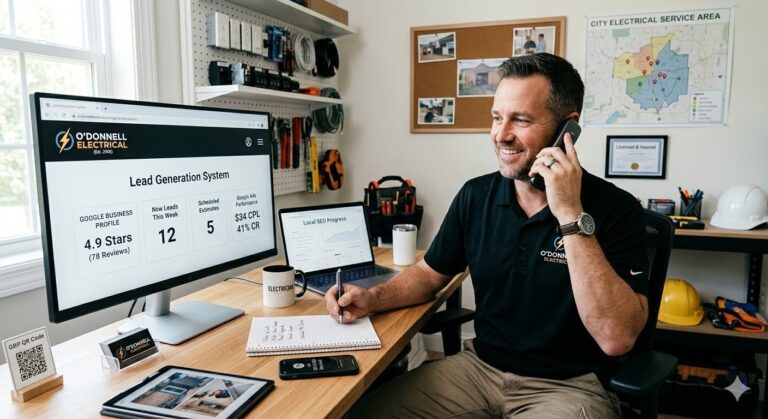
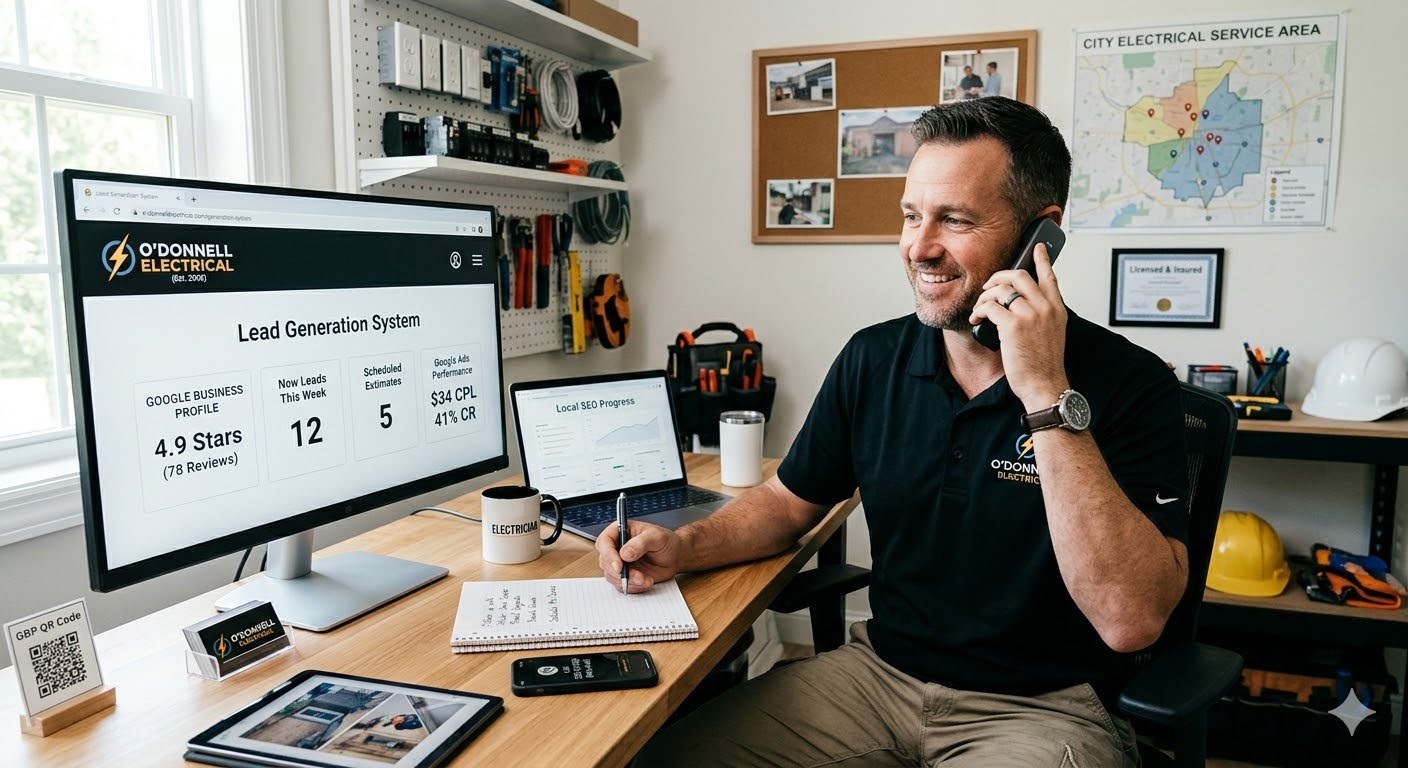
I started with $20 a day, one ad group targeting “emergency electrician [my city],” and a landing page that was just my contact form with a big headline: “Same-Day Emergency Service—Call Now.” I tracked every call. I knew my cost per lead ($34), my close rate (41%), and my average job value ($680).
The math worked, so I scaled to $50 a day. If the math hadn’t worked, I would’ve killed it and focused on the free channels.
That’s the order:
- Own your GBP
- Fix your follow-up
- Build basic local SEO
- Test paid ads if you want to accelerate
Don’t skip steps. Don’t start with the expensive stuff and hope it compensates for a weak foundation.
What This Looks Like in Practice (Real Numbers, Real Timeline)
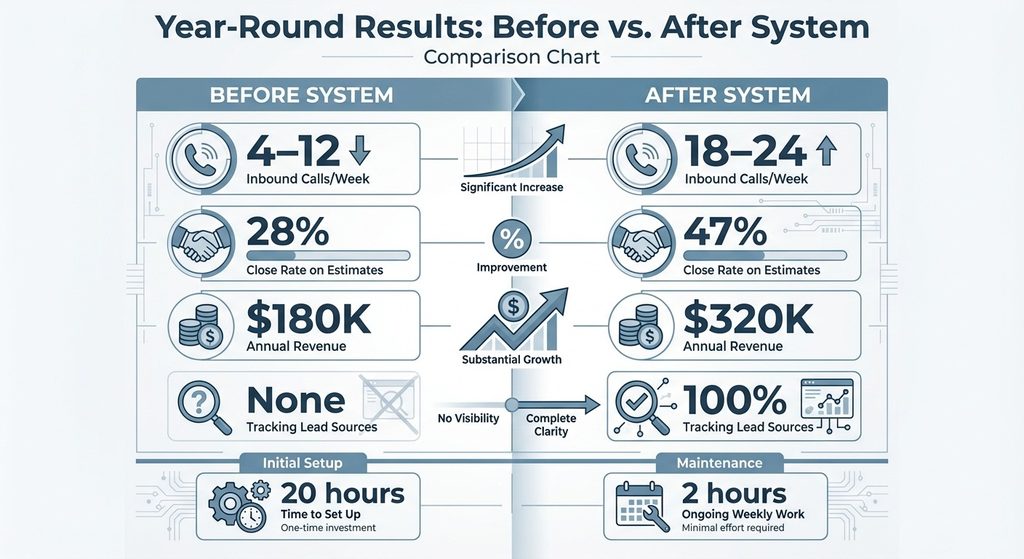
Here’s what my lead flow looked like six months after I built this system, compared to the year before when I was winging it:
| Metric | Before System | After System |
|---|---|---|
| Weekly inbound calls | 4-12 (inconsistent) | 18-24 (steady) |
| Estimate close rate | 28% | 47% |
| Lead attribution | Zero tracking | Full visibility |
| Slow months per year | 3 months scrambling | Booked 4 weeks out year-round |
| Annual revenue | $180K | $320K |
Same crew size. Same service area.
I just stopped losing leads I’d already paid for, and I built channels that fed me work whether I was marketing that week or not.
The Real Time Investment
The time investment was front-loaded: maybe 20 hours total to set up GBP, build follow-up processes, and launch a basic PPC campaign. After that, it was two hours a week—posting to GBP, checking ad performance, asking for reviews, reaching out to referral partners.
My office person handled most of the follow-up once I trained her on the system.
The One Thing That Breaks Everything (And How to Avoid It)
The system only works if you actually work the system.
I’ve watched contractors set up a perfect GBP, launch ads, build a CRM—and then stop following up after two weeks because they got busy. The leads dry up, they blame the channel, and they’re back to feast-or-famine.
You can’t treat lead generation like a project you finish. It’s a rhythm. Weekly GBP posts. Daily follow-up on open estimates. Monthly review of ad performance and referral sources. If you’re too busy to do it, hire someone part-time or train your spouse or office person.
But don’t let it slide, because your competitors won’t.
The Burnout Trap (And How to Sidestep It)
The other thing that breaks the system: trying to do everything at once. I see electricians launch Google Ads, Facebook Ads, SEO, and a referral program in the same month, then burn out and quit all of it.
Pick one channel, make it work, then add the next.
- GBP first
- Follow-up second
- Local SEO third
- Paid ads fourth
- Partnerships and referrals as ongoing maintenance
And with infrastructure expanding—capacity projections show 63 GW of new generating capacity in 2025, led by solar—the work is coming. The question is whether you’ll have a system to capture it, or whether you’ll still be hoping your phone rings.
For more on building a lead generation for electricians system that actually fits a small shop, the tactics are out there. You just have to stop treating it like a gamble and start treating it like the skill it is—one you can learn, test, and refine until the phone rings every week without you crossing your fingers.
About the Author