
Construction Companies That Rank on Google Win More Bids and Here Is the Playbook
I heard the same story three times last month. Three different owners, same complaint: “We paid an SEO company for six months. Got beautiful reports every week. Phone never rang.”
That’s the problem with most SEO advice for construction companies—it’s written by people who’ve never run a crew, never sweated a bid deadline, and sure as hell never had to explain to a bank why the pipeline dried up. So here’s what I’m going to do instead: walk you through SEO the way I’d walk you through a scope of work. Clear deliverables. Measurable outcomes. No jargon unless I explain exactly what it does and why it matters to your bottom line.
Why Your Competitors Are Showing Up and You’re Not
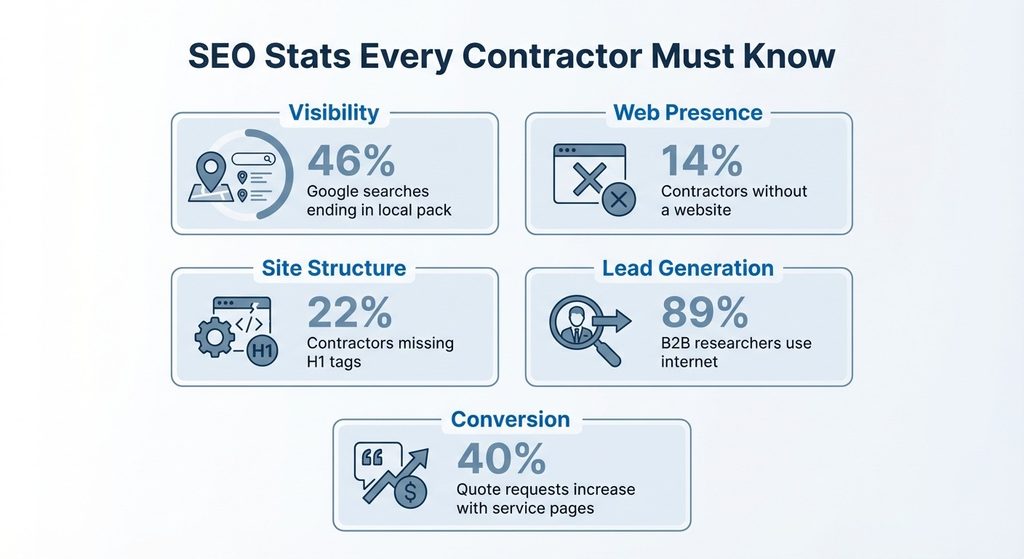
The local pack—that’s the map with three business listings Google shows when someone searches “commercial roofing Denver” or “concrete contractor near me”—is where 46% of all Google searches end up.
If you’re not in those three spots, you’re invisible to half the people looking for exactly what you do.
I started paying attention to this after a PM called me, frustrated. He’d just lost a retail build-out to a competitor who wasn’t cheaper, wasn’t faster, and frankly wasn’t better. The GC found them on Google. Clicked. Called. Done.
Here’s what I found: recent contractor research shows 14% of contractors don’t even have a website. Another chunk have sites but never claimed their Google Business Profile. The bar is shockingly low, which means the opportunity is wide open.
What to Fix First: Your Google Business Profile
Think of your Google Business Profile (GBP) as your digital storefront. If someone searches “excavation contractor Raleigh,” Google decides who shows up in that local pack based on three things:
| Ranking Factor | What It Means | Your Control Level |
|---|---|---|
| Relevance | Does your profile match what they searched? | Complete control |
| Distance | How close are you to the searcher? | No control |
| Prominence | How much does Google trust you? | Complete control |
You control two of those three completely.
Start by claiming your profile at google.com/business. Then fill out every single field. Business name, address, phone number, hours, services, service area. Complete it like you’d complete a permit application, because Google rewards thoroughness.
Writing a Business Description That Actually Works
Your business description matters more than you think.
Don’t write “We do quality work.” Write “Licensed commercial concrete contractor serving Raleigh, Durham, and Chapel Hill since 2008. Specializing in tilt-up construction, structural slabs, and site concrete for retail and industrial projects.” That’s specific. That’s searchable.
The Photo Strategy Nobody Talks About
Upload at least ten photos: your trucks with your logo visible, your crew on-site, finished projects. Update them every month. Google prioritizes active profiles over stale ones.
Reviews are the other half of prominence. After every completed project, ask the client to leave a review. Send them a direct link. Respond to every review within 48 hours.
Google Posts are short updates you can publish directly to your GBP—project completions, new service offerings, seasonal reminders. Post once a week. It takes five minutes and keeps you front of mind.
Building Landing Pages That Actually Convert Searches Into Calls
Your homepage can’t do everything.
If someone searches “metal building contractor Austin,” they don’t want to land on a generic homepage. They want to know you build metal buildings in Austin, what that costs, and how to get a quote.
Create a dedicated page for each major service in each city or region you serve. “Commercial Roofing in Fort Worth.” “Residential Framing in Plano.” “Tenant Improvement Construction in Dallas.”
Finding the Keywords Your Prospects Actually Use
Use Google’s autocomplete—start typing “concrete contractor” and see what Google suggests. Check “People also ask” boxes on search results pages. Look at what your competitors are ranking for. You’re looking for phrases that combine your service with a location: “concrete slab contractor near me,” “foundation repair Fort Worth,” “commercial concrete Dallas.”
Build the page around that phrase. Your H1 tag—the main headline—should be clear: “Commercial Concrete Contractor in Fort Worth.” A recent audit found 22% of contractors are missing H1 tags entirely.
The body content should answer the questions a prospect has before they call:
- What services do you offer?
- What’s your service area?
- What types of projects do you handle?
- How long does it take?
- What’s the process?
Include specifics: “We pour structural slabs for commercial buildings from 5,000 to 50,000 square feet throughout Tarrant County.”
Calls to Action That Convert
Your call to action needs to be obvious and repeated. “Request a Free Estimate” buttons at the top, middle, and bottom of the page. Your phone number in the header, clickable on mobile. A contact form that asks for name, phone, email, project type, and location—nothing more.
If you serve multiple cities, build multiple pages. A contractor who has dedicated pages for seo for construction companies in five surrounding suburbs will capture leads that a single generic page misses.
Citations and Backlinks: Building Your Digital Reputation
Citations are simple: your business name, address, and phone number listed on other websites. The more consistent references you have across the web, the more Google trusts that you’re a real, established business.
Essential Citation Sources:
- Yelp
- Angi
- HomeAdvisor
- Houzz
- Better Business Bureau
- Local Chamber of Commerce
Make sure your NAP (name, address, phone) is identical on every single listing. If your GBP says “ABC Construction LLC” but Yelp says “ABC Construction,” Google sees that as two different businesses.
Then go niche. Find construction-specific directories, regional business listings, and trade association sites.
How Backlinks Actually Work
Backlinks are when another website links to yours. Google treats backlinks like endorsements. If a respected local news site, a supplier’s blog, or a commercial real estate website links to you, Google assumes you’re credible.
You earn backlinks by being worth linking to:
- Sponsor a local Little League team and get a link from the league website
- Write a guest article for a local business journal
- Get featured in a case study by a supplier or manufacturer you work with
- Offer to be quoted in a journalist’s article about local development projects
Build relationships with local suppliers and subcontractors and ask if they’ll link to you from their “preferred contractors” or “partners” pages.
Avoid link farms, paid link schemes, or anything that feels sketchy. Google’s smarter than it used to be, and low-quality backlinks can hurt you worse than no backlinks at all.
Schema Markup: The Technical Detail That Drives Calls
Schema markup is code you add to your website that helps Google understand what your business does. It’s the difference between Google seeing a block of text and Google seeing “This is a commercial contractor. Here are their services. Here’s their service area. Here are their reviews.”
Most modern website platforms have plugins that handle it. But you need to make sure it’s there and accurate.
The Four Schema Types That Matter Most
LocalBusiness schema tells Google your business name, address, phone, hours, and service area.
Service schema lists each service you offer—concrete, framing, roofing, whatever.
Review schema displays your star rating in search results. When someone sees your listing with 4.8 stars next to it, your click-through rate jumps.
Breadcrumb schema shows the page hierarchy in search results, making it easier for users to navigate.
Check if your schema is working using Google’s Rich Results Test tool. Paste in your URL, and it’ll show you what Google sees.
How to Measure Leads, Not Just Rankings
Most SEO companies send reports full of keyword rankings and traffic graphs, but none of it ties back to whether the phone rang.
Setting Up Call Tracking
Use a service like CallRail or CallTrackingMetrics that gives you a unique phone number for your website. When someone calls that number, you know they found you online.
Tracking Form Submissions
Track form submissions in Google Analytics. Set up goals so every time someone fills out your “Request a Quote” form, it logs as a conversion.
Monitoring GBP Performance
Monitor your Google Business Profile insights. GBP shows you how many people viewed your profile, clicked for directions, clicked your website, and called.
Calculating Real ROI
Compare lead volume to close rate. If you’re getting 20 quote requests a month from organic search and closing four of them, that’s a 20% close rate. If your average project is worth $50,000, that’s $200,000 in monthly revenue from SEO.
Industry research confirms that 89% of B2B researchers use the internet during their research process. That includes general contractors looking for subs, property managers looking for maintenance contractors, and developers looking for builders.
Comparing In-House Effort vs. Hiring Help
You’ve got two paths: do it yourself or hire someone who knows what they’re doing.
| Approach | Time Investment | Cost | Control Level | Speed to Results |
|---|---|---|---|---|
| In-House | 10-15 hrs/week | Lower | Complete | Slower (learning curve) |
| Agency/Consultant | Minimal oversight | Higher | Shared | Faster (expertise) |
| Hybrid | 5-8 hrs/week | Moderate | High | Moderate |
If you go in-house, you need someone who can commit 10-15 hours a week minimum. The upside is control and cost savings. The downside is the learning curve.
If you hire an agency or consultant, you’re paying for expertise and speed. A good SEO partner should give you a clear scope: what they’ll do, what timeline to expect, and what metrics they’ll track. They should talk about calls and leads, not just rankings.
Red Flags to Watch For
Anyone who guarantees page-one rankings in 30 days. Anyone who won’t explain their tactics. Anyone who wants a long-term contract with no performance benchmarks. Marketing data shows contractors are increasingly leveraging SEO, PPC, and social media to generate leads—which means the market is getting more competitive.
A hybrid approach works well: hire someone to set up the foundation (GBP optimization, schema, initial landing pages, citation cleanup) and then manage ongoing updates in-house.
Your 90-Day Implementation Roadmap
You don’t need to do all of this at once. Here’s the priority order:
First 30 days: Claim and fully optimize your Google Business Profile. Upload photos. Get your first ten reviews. Make sure your NAP is consistent everywhere.
Days 30-60: Build service-area landing pages for your top three services in your primary market. Optimize them with clear H1 tags, detailed content, and strong calls to action. Add schema markup.
Days 60-90: Clean up your citations. Get listed in the major directories. Start reaching out for backlinks from local partners and suppliers.
Month four and beyond: Keep your GBP active with weekly posts and fresh photos. Add more service-area pages as you expand. Track your metrics monthly and adjust based on what’s driving calls.
This isn’t set-it-and-forget-it. It’s ongoing, like maintaining your equipment. But unlike a lot of marketing tactics that feel like throwing money into a void, SEO gives you measurable, controllable results.
What Happens Next
The next major project lead sitting in your pipeline right now might come from a Google search you haven’t optimized for yet.
The question is whether you’re going to be in that local pack when they search, or whether they’re going to call your competitor instead.
About the Author