
The Construction Marketing Strategy That Actually Brings in Contracts—Without Wasting Your Budget
I spent eight years running crews before I ever touched a marketing dashboard. Back then, if you asked me about SEO or PPC, I’d have told you it sounded like something a consultant sells you right before your bank account gets lighter and your phone stays quiet.
Now I run marketing for a 12-person GC, and I’m watching the same pattern play out: “Tried Google Ads, burned through $3K, got two tire-kickers.” “Posted on Instagram for six months—crickets.” “My GMB got suspended and I don’t know why.”
The phone stops ringing, the backlog thins out, and suddenly you’re scrambling to figure out where the next three months of work are coming from.
Here’s the mistake: treating marketing like a random toolbox where you grab whatever’s shiny—a Facebook page here, some PPC there, maybe a website refresh—without any system to track what’s actually producing calls, bids, and signed contracts. You end up spending money on tactics that feel like marketing but don’t move the needle on revenue. Then you conclude marketing doesn’t work for construction, when the real problem is you never built a strategy that connects each channel to measurable lead flow and ROI.
This isn’t about doing more.
It’s about doing less, but doing it right—with every dollar and hour tied to a number you can track. I’m going to walk you through the exact framework we use to generate consistent leads, the channels that matter most for contractors, and how to prove ROI so you’re never guessing whether your marketing budget is working or wasting.
The Three Myths Killing Your Lead Generation Right Now
Before we build anything, let’s kill the advice that’s costing you jobs.
Myth #1: “You Need to Post Every Day on Social Media”
No, you don’t. Unless you’re selling consumer products to homeowners scrolling at 9 PM, daily posts are a time suck that rarely converts into commercial work or high-ticket residential projects. Social has a role—we’ll get to it—but it’s not your lead engine.
Myth #2: “Just Run Google Ads and the Leads Will Come”
PPC without the right landing page, tracking, and follow-up system is like pouring concrete without rebar. You’ll get clicks, maybe even form fills, but if those leads aren’t qualified or you can’t close them, you’ve just bought expensive disappointment.
I’ve seen contractors spend $5K/month on ads with zero closed jobs because they sent traffic to a generic homepage and never called anyone back within two hours.
Myth #3: “SEO Takes Too Long, So Skip It”
Yes, SEO is a six-to-twelve-month play. But if you’re planning to be in business next year—and the year after—you need owned traffic that doesn’t cost you $80 per click. The contractors who ignored SEO three years ago are now paying 40% more per lead than the ones who started early.
The Lead-Gen Framework That Actually Works for Contractors
Here’s the system: positioning and offer → local search dominance → paid demand capture → proof and nurture → tracking and optimization.
Every piece feeds the next. You don’t need all of it on day one, but you need to understand how it fits together so you’re not just throwing tactics at the wall.
Start With Positioning and Offer
Before you spend a dollar on ads or SEO, get clear on who you serve and what problem you solve better than anyone else in your market.
Are you the commercial TI specialist who finishes on time? The residential remodeler who handles permitting nightmares? The concrete contractor who works in freeze-thaw climates?
Specificity wins. Generic “we do everything” messaging loses to competitors who own a niche.
Your offer isn’t just “we build stuff.” It’s the outcome your client gets and the risk you remove. For commercial, that might be guaranteed schedule adherence with liquidated damages protection. For residential, it’s fixed-price contracts with a change-order process that doesn’t surprise anyone.
Then Build Local Search Dominance
This is SEO plus Google My Business, and it’s the foundation of predictable inbound leads. When someone in your service area searches “commercial general contractor near me” or “kitchen remodel [your city],” you want to own the map pack and the organic results below it.
For SEO, that means a website with service pages for each trade and location you cover, project galleries with real photos (not stock), and content that answers the questions your prospects actually ask—permit timelines, cost ranges, what to expect during demo. Write about “how long does a commercial buildout take in [your city]” and “what permits do I need for a second-story addition.”
For Google My Business, claim and verify your profile, choose the right categories (be specific—”concrete contractor” beats “general contractor” if that’s your core work), upload job photos every week, and respond to every review within 24 hours. GMB is free, it’s local, and it’s the first thing most prospects see.
If your profile is incomplete or your reviews are stale, you’re losing bids before anyone even calls.
We track GMB views, clicks, and calls in the Insights tab—it’s one of the cleanest signals of local demand you’ll get. A well-optimized construction marketing strategy integrates these tactics into a system that compounds over time, not a one-off campaign that fades after three months.
Next, Layer in Paid Demand Capture
PPC—Google Ads, specifically—is how you buy your way to the top while SEO builds. But you have to do it right.
Start with Google Search Ads targeting high-intent keywords: “hire concrete contractor [city],” “commercial GC [city],” “emergency roof repair [city].” Avoid broad terms like “construction” or “remodeling ideas”—you’ll burn budget on curiosity clicks, not buyers.
Send that traffic to a dedicated landing page, not your homepage. One service, one offer, one call to action.
If you’re running ads for commercial tenant improvements, the landing page should show TI projects, explain your process, and have a form or phone number above the fold. Track every conversion—form fills, phone calls (use call tracking), and chat messages—so you know exactly what you’re paying per lead.
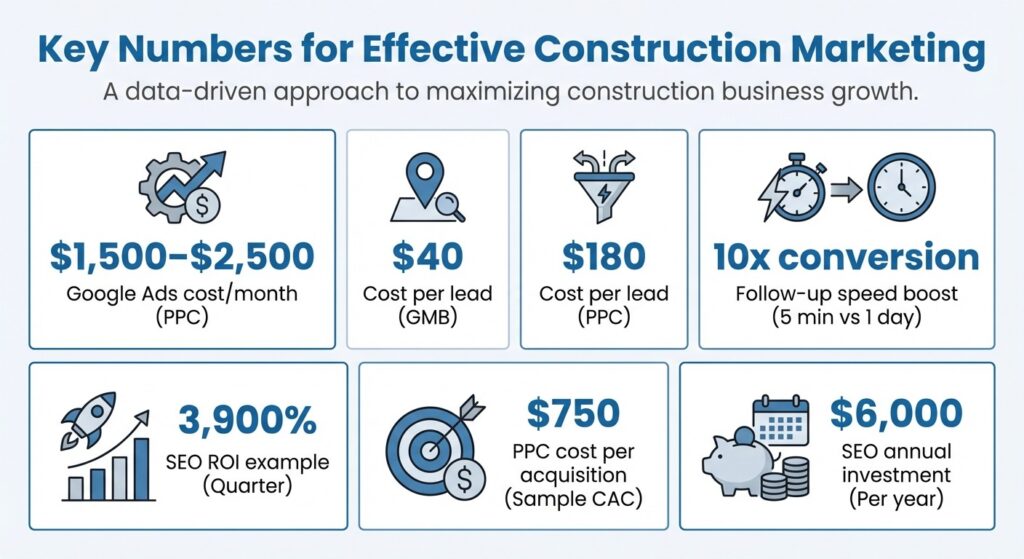
Budget-wise, start small. $1,500 to $2,500/month is enough to test in most markets. Watch your cost per lead and cost per acquisition. If you’re spending $150 per lead and closing one in five at an average project value of $75K, your CAC is $750 and your ROI is crystal clear. If you’re spending $150 per lead and closing zero, either your targeting is off, your landing page isn’t converting, or your follow-up is broken.
The CRM and Tracking System That Proves ROI
This is where most contractors lose the thread.
You’re getting leads from SEO, GMB, PPC, maybe referrals—but if you’re not tracking where they came from, how fast you followed up, and whether they turned into revenue, you’re flying blind.
You need a CRM. It doesn’t have to be fancy. We use a simple system that logs every lead with a source tag (Google Ads, GMB, organic search, referral), a timestamp, and a status (contacted, quoted, won, lost). When a lead comes in, it gets a follow-up task within two hours.
Speed matters—contractors who call back in five minutes convert at significantly higher rates than those who wait a day.
The Numbers You Must Track Weekly
- Leads by source — Which channels are actually producing?
- Contact rate — Are you reaching people who fill out forms?
- Quote rate — How many conversations turn into estimates?
- Close rate — What percentage of quotes become signed contracts?
- Average project value — Are you attracting the right-sized jobs?
- Cost per lead — What are you paying for each opportunity?
- Cost per acquisition — What does a closed job actually cost you?
When you see that GMB is generating leads at $40 each and PPC is generating leads at $180 each, but PPC leads close at twice the rate, you can make smart decisions about where to invest more.
ROI tracking is simple math: revenue from marketing-sourced jobs minus marketing cost, divided by marketing cost. If you spent $5K on ads and SEO last quarter and closed $200K in projects that came from those channels, your ROI is 3,900%. Even if you only attribute half of those projects to marketing, you’re still at a 1,900% return.
Case Studies and Social Proof: The Content That Converts
Here’s where case studies and social media actually earn their keep—not as lead-gen engines, but as trust-builders and conversion accelerants.
A good case study walks through a real project: the client’s problem, your solution, the obstacles you handled, and the outcome. For commercial work, include square footage, timeline, and any complexity (occupied building, phased delivery, design-build). For residential, show before-and-after photos, budget range, and what made the client nervous before they hired you.
Post case studies on your website, share them in proposals, and use snippets in your Google Ads and GMB posts. When a prospect is deciding between you and two other GCs, the one with documented proof of similar work wins.
How to Actually Use Social Media (Without Wasting Time)
Social media—Facebook, Instagram, LinkedIn—supports this. You’re not trying to go viral. You’re staying visible to past clients (who refer), showing progress on active jobs (which builds credibility), and retargeting website visitors with project photos and testimonials.
Post twice a week: one project update, one client win or review. That’s it.
Use social ads for retargeting only. Someone visited your landing page but didn’t convert? Show them a case study or a testimonial for the next two weeks. Retargeting is cheap ($200-$500/month) and effective because you’re reaching warm traffic, not cold audiences.
The 90-Day Implementation Checklist
You don’t need to do everything at once. Here’s the sequence that works when you’re starting from scratch or fixing a broken system.
Month One: Foundation
- Audit your positioning—do you have a clear niche and offer? If not, define it.
- Claim and optimize your Google My Business profile.
- Set up call tracking and a basic CRM (even a spreadsheet works).
- Launch one service page on your website with real project photos and a contact form.
- Start collecting reviews—ask every satisfied client, make it easy with a direct link.
Month Two: Local Search
- Add three more service pages to your website, each targeting a specific trade or project type in your area.
- Write one piece of content answering a common client question.
- Submit your site to local directories (Yelp, Houzz, Angi).
- Post to GMB twice a week—project photos, not stock images.
- Track your GMB Insights to see search volume and actions.
Month Three: Paid and Proof
- Launch a small Google Search Ads campaign targeting your top two services.
- Build a dedicated landing page for each.
- Set up conversion tracking.
- Create your first case study and post it to your website and social channels.
- Set up a retargeting campaign on Facebook or Google Display.
- Review your CRM data—what’s your lead-to-close rate? Where are leads dropping off?
By day 90, you should have inbound leads from GMB, early organic traffic from SEO, and paid leads from PPC. You’ll know your cost per lead, your close rate, and your ROI. That’s when you double down on what’s working and cut what’s not.
What Happens When You Actually Track and Optimize
Six months in, the system starts compounding.
Your SEO rankings improve, your GMB profile gets more reviews and clicks, your PPC campaigns get smarter as you learn which keywords and landing pages convert. You’re not scrambling for the next job—you’re choosing between qualified leads.
I’ve seen a residential remodeler go from three referral-based projects a year to twelve inbound projects, half from organic search and GMB. A commercial GC cut their cost per lead from $220 to $95 by tightening their ad targeting and improving their landing page. A concrete contractor closed $400K in work from a $6K annual SEO investment because they ranked first for every high-intent search in their county.
The difference isn’t magic.
It’s a system that connects every channel to a measurable outcome, tracks what’s working, and kills what’s not. It’s treating marketing like a job you manage, not a mystery you hope solves itself.
You’re not going to fix this overnight. But if you start now—positioning, local search, paid capture, proof, tracking—you’ll have a pipeline you control instead of one that controls you.
And six months from now, when someone in a forum asks “how do I get more leads,” you’ll be the one with an answer that actually works.
About the Author