Plumbing Businesses That Never Run Dry on Leads Follow These Simple but Effective Strategies
I still remember the Thursday night I answered a 9pm dispatch call, standing in my kitchen with a sink full of dishes, and the owner on the other end said, “I don’t know if I can keep the second truck next month.” He’d spent $1,800 on Google Ads that week. Phones rang. But when I asked how many jobs actually booked, he went quiet.
That silence is everywhere now—in YouTube comments, in DMs from owners who just want to sleep without checking tomorrow’s schedule at 2am. The pattern is always the same: they’re spending money, leads are coming in, but the calendar still has gaps.
And the real frustration isn’t the empty slots—it’s not knowing which marketing dollar actually put a job on the board.
The Real Problem Isn’t Lead Volume—It’s Lead Chaos
Most plumbing companies I work with don’t have a lead shortage. They have a system shortage.
Here’s what that looks like in practice:
| Symptom | What It Really Means |
|---|---|
| 47 calls in a week, 3 jobs booked | Lead quality problem or broken sales process |
| Google Business Profile views but no clicks | Missing trust signals or unclear messaging |
| Good months and bad months with no pattern | Zero tracking, pure guesswork |
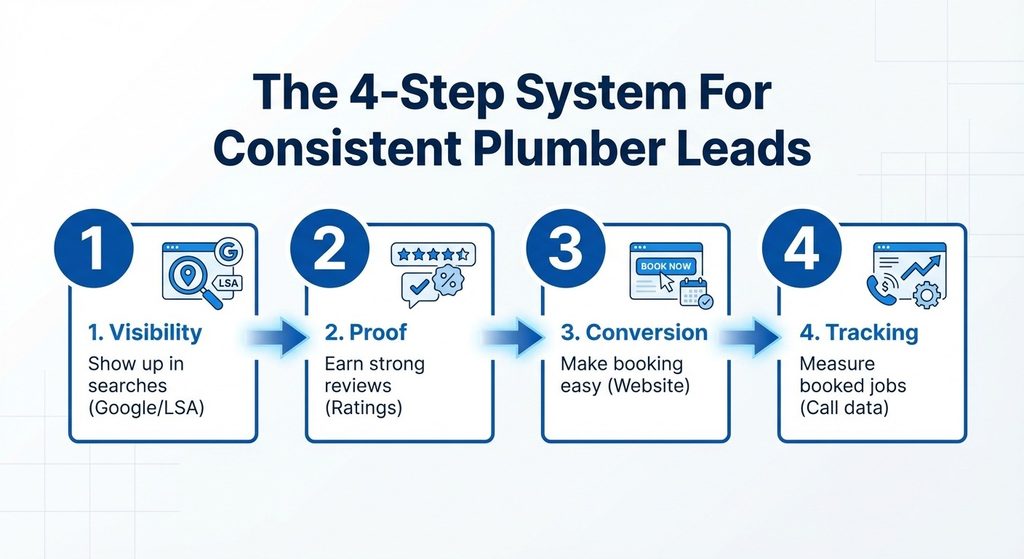
The difference between companies with reliably full calendars and those riding seasonal whiplash isn’t luck or ad spend. It’s whether they built a pipeline that moves people from “I need a plumber” to “I’m booking you” without leaking prospects at every turn. Companies that never panic about next month run the same four-part system: visibility that puts them in front of ready buyers, proof that makes strangers trust them, a website that converts clicks into calls, and tracking that shows exactly what’s working.
If you’re judging marketing by “calls today,” you’re measuring the wrong thing. The only number that matters is booked jobs per dollar spent—and to get that number, you need to see the whole path from search to schedule.
The Four-Layer System That Fills Calendars (Without Guessing)
Think of lead generation like a water system. Visibility is the main line bringing flow to your property. Proof is the pressure regulator that keeps it moving. Conversion is the faucet that actually delivers water where you need it. And tracking is the meter that tells you if you’re paying for water you’re not using.
Layer One: Visibility
Showing up when someone in your service area searches “plumber near me” or “emergency drain cleaning” right now. That means your Google Business Profile is claimed, verified, and updated weekly with posts and photos. It means you’re running Local Service Ads so Google puts your business at the very top with the green checkmark.
Most owners I talk to have heard of GBP and LSAs but treat them like optional extras. They’re not. They’re the main line.
Layer Two: Proof
The reviews and ratings that turn a search result into a phone call. I’ve watched owners lose jobs to competitors with worse pricing but better reviews. When someone’s water heater just flooded the basement, they’re scanning star counts and reading the top three reviews.
If yours say “showed up fast, fixed it right, didn’t overcharge,” you’re in. If you have six reviews from 2019, you’re out. The market is expanding—industry growth data shows steady demand increases—but that growth is going to companies that look trustworthy online, not just companies that are trustworthy in the field.
Layer Three: Conversion
What happens when someone lands on your website or calls your number. If your site doesn’t load on mobile, doesn’t show your service area clearly, or makes people hunt for a phone number, you’re paying for traffic that bounces. If calls go to voicemail during business hours or your booking process requires three phone calls before you can quote, you’re losing jobs to competitors who make it easier.
Conversion isn’t about fancy design. It’s about removing every excuse not to book.
Layer Four: Control
The call tracking and booking tools that show you which lead sources actually produce revenue. Without it, you’re flying blind. You don’t know if your LSA budget is bringing in $50 jobs or $5,000 jobs. You don’t know if your Google Ads are generating booked work or tire-kickers who call six companies and ghost all of them.
When you can’t see what’s working, you either overspend on everything or cut the wrong thing and lose the leads that were actually paying off.
How to Build Visibility That Brings Ready-to-Book Customers
Start with your Google Business Profile because it’s free, it’s fast, and it’s the first thing people see when they search. If you haven’t claimed it yet, do that today—go to google.com/business and follow the verification steps.
Your Weekly GBP Checklist:
- Post at least once (job photo, quick tip, emergency availability reminder)
- Respond to all new reviews within 24 hours
- Upload fresh photos of your team, trucks, or completed work
- Check and update service area descriptions
- Verify business hours are current
Google rewards active profiles with better placement in local search. Add your service areas explicitly in the business description. Profiles with photos get more clicks, and more clicks mean more calls.
Then turn on Local Service Ads.
Yes, they cost money per lead. But LSAs put you at the top of search results with a Google Guaranteed badge, and that badge converts better than any ad copy you’ll ever write. The key is setting your budget based on booked job value, not lead cost. If you’re paying $30 per lead and closing one in five, that’s $150 in lead cost per job. If your average job is $800, that’s profitable. If your average job is $200, it’s not.
Track your LSA performance weekly. Google gives you data on how many leads came in, how many you responded to, and your response time. If you’re slow to respond, your cost per lead goes up because Google penalizes you in the algorithm. The system rewards fast, consistent responses—which brings us to conversion.
Turning Proof Into Trust: The Review System That Actually Works
I hear the same thing in every YouTube thread: “Asking for reviews feels awkward.” I get it. You just fixed someone’s toilet—asking them to write a paragraph about it feels weird.
But here’s what I learned after setting up review systems for 30+ companies: you’re not asking them to do you a favor. You’re giving them a way to help the next person who’s panicking about a burst pipe at midnight.
The best time to ask is right after you finish the job, while you’re still standing there. Not in a pushy way—just, “Hey, if you’re happy with how this turned out, a quick review on Google really helps other folks find us when they’re in a bind. I can text you the link right now if that’s easier.”
Most people say yes. Some forget. That’s fine.
Send a follow-up text an hour later with the direct link to your Google review page. Make it one click—no login required, no hunting through your profile. Use a tool like Podium or Birdeye if you’re doing volume, or just save a text template with the link and send it manually.
The goal is five to ten new reviews per month, minimum. That’s enough to stay fresh in search results and enough to outpace competitors sitting on old reviews.
What to Do When You Get a Bad Review
Respond fast and professionally. Apologize for the experience, explain what you’ll do differently, offer to make it right.
Future customers read your response more than the complaint itself. A company that ignores bad reviews looks careless. A company that fixes problems looks trustworthy.
Website Conversion: The Difference Between Clicks and Calls
Your website has one job: make it easy to book you. That’s it.
If someone lands on your homepage and can’t find your phone number in three seconds, you’ve lost them. If your site takes ten seconds to load on a phone, you’ve lost them. If they have to fill out a form and wait for a callback instead of just calling now, you’ve probably lost them.
Essential Website Elements:
- Phone number in the header of every page, big and clickable
- “Book Now” button that triggers a call or opens scheduling
- Service area displayed prominently on homepage
- Clear service descriptions without jargon
- Mobile load time under 3 seconds
“Water heater repair and replacement” beats “comprehensive thermal fluid system solutions.”
If you’re running paid ads—Google Ads, Facebook, LSAs—send that traffic to a dedicated landing page, not your homepage. A landing page for “emergency drain cleaning” should show drain cleaning photos, drain cleaning reviews, drain cleaning pricing (even a range), and a big call button. Don’t distract them with your full service menu.
The tighter the match between what they searched and what they see, the higher your conversion rate.
Add booking tools if your calendar can handle it. Tools like Housecall Pro, Jobber, or ServiceTitan let customers book directly online, which removes the friction of phone tag. You control the parameters—set minimum job types, require deposits for certain services, block out times you’re not available.
Companies that added booking tools saw their no-show rate drop because customers who book themselves are more committed than customers who half-remember a phone call.
Call Tracking and Booking Tools: How to Know What’s Actually Working
This is where most owners check out because it sounds technical. But call tracking is simpler than you think, and it’s the only way to stop guessing about ROI.
Here’s the basic version: you get unique phone numbers for each marketing source—one for your website, one for your Google Ads, one for your LSAs, one for your truck wrap. When someone calls, the system logs which number they dialed, records the call, and tracks whether it turned into a booked job.
I use CallRail for most of my clients because it’s affordable and integrates with Google Ads. The setup takes an afternoon. The payoff is knowing that your Google Ads are generating $4,000 in booked revenue per month while your Facebook ads are generating $200—which means you kill the Facebook budget and double down on Google.
The Three Numbers That Matter
| Metric | Why It Matters | What Good Looks Like |
|---|---|---|
| Total Calls | Vanity metric—shows activity, not results | 50+ per week |
| Booked Calls | Reality check—actual revenue opportunities | 20-30% of total calls |
| Cost Per Booked Call | Profitability indicator | Under 15% of average job value |
If you’re getting 50 calls a week but only booking 10 jobs, your problem isn’t lead volume—it’s either lead quality (wrong targeting) or sales process (poor phone handling, slow follow-up, bad pricing). Cost per booked call tells you what you can afford to spend. If your average job is $600 and your cost per booked call is $75, you’re profitable. If it’s $200, you’re not.
Booking tools tie into this because they reduce the friction between “interested” and “scheduled.” When someone calls and you say, “I can get you on the calendar right now,” and you actually do it while they’re on the phone, your close rate goes up.
Tools like Jobber and Housecall Pro sync your calendar in real time so your CSR or dispatcher can see availability instantly and lock in the appointment before the customer hangs up and calls your competitor.
The Support System: Referrals and Seasonal Prep
Once your core pipeline is running—visibility, proof, conversion, tracking—you can layer in referral programs and seasonal strategies without them feeling like desperate Hail Marys.
Referrals work best when you make them easy and rewarding. Give existing customers a reason to send you business: $50 off their next service for every referral that books, or a free maintenance check after three referrals. Print simple cards they can hand to neighbors.
Seasonal prep means ramping up your visibility before the busy season hits, not during.
If you’re in a cold climate, start pushing furnace and water heater messaging in September, not November. If you’re in a hot climate, start talking AC and irrigation in March, not June. Use Google Ads seasonal campaigns, update your GBP posts with timely content, send email reminders to past customers about maintenance.
The companies that never panic during slow months are the ones who built their pipeline during the last slow month, not the current one.
What to Do When Leads Aren’t Converting
If you’re getting calls but not booking jobs, the problem is usually one of three things: wrong leads, wrong pricing, or wrong process.
Wrong leads means your targeting is off—your LSAs are set too wide, your Google Ads keywords are too broad, or your GBP categories don’t match what you actually do. Tighten your service area, add negative keywords (like “DIY” or “free”), and make sure your ad copy is clear about what you offer.
Wrong pricing means you’re either too high for your market or you’re not communicating value. If competitors are booking the same jobs at the same price, the issue isn’t your rate—it’s how you present it. Lead with the outcome, not the task: “We’ll have your hot water running again today” beats “We install water heaters.”
Wrong process means slow follow-up, unclear next steps, or making customers jump through hoops. Call leads back within five minutes. Confirm appointments via text. Show up on time.
It’s basic, but it’s where most companies lose winnable jobs.
Your 90-Day Build: From Chaos to Predictable Calendar
Month One: Foundation
Claim and optimize your Google Business Profile, turn on Local Service Ads with a small test budget, and set up basic call tracking. Post to GBP twice a week. Respond to every review. Get ten new reviews by asking every satisfied customer.
Month Two: Conversion
Audit your website for mobile speed and conversion. Add or fix your “Book Now” button. Create one dedicated landing page for your most profitable service and run a small Google Ads campaign to it. Track calls, booked jobs, and cost per booked call weekly. Adjust your LSA budget based on what’s actually closing.
Month Three: Optimization
Add booking tools if your volume supports it. Launch a simple referral program. Review your tracking data and double down on what’s working—kill what’s not. By now you should see patterns: which lead sources book best, which services are most profitable, which days and times convert highest.
Use that data to guide every decision going forward.
The companies that never worry about next month’s calendar aren’t doing anything magical. They built a system that brings in leads, converts them into jobs, and tracks what’s working so they can do more of it. It’s not fast, it’s not flashy, but it’s reliable—and reliable is what lets you sleep at night.
That’s the difference between lead generation for plumbers that feels like gambling and lead generation that feels like running a business.
The work isn’t complicated. It’s just consistent. And if you’re tired of guessing whether your marketing is working, start with visibility and proof this week. Everything else builds from there.
About the Author