
Architecture Firms That Grow Their Client Base Do These Marketing Things Differently
I’ve sat through enough webinar Q&As to recognize the pattern. Someone asks about marketing for their architecture firm, and within three comments, the thread devolves into “marketing doesn’t work in architecture—it’s all relationships.”
I get it. I spent years in AEC marketing before shifting to fractional growth strategy, and I’ve heard every version of this objection. The problem isn’t that the statement is wrong—relationships do drive work. The problem is the false choice it creates.
The firms I work with who’ve cracked consistent growth aren’t choosing between relationships and marketing. They’re using marketing for architects to multiply what their relationships already produce. When a past client thinks of you six months after project completion, do they find a stale website or a portfolio that demonstrates your evolution? When a referral Googles your firm name, does your work speak for itself or does a competitor’s better-optimized site appear first?
Over the past year, I’ve reviewed dozens of firm websites, portfolios, and proposal pipelines for principals reporting the same frustration: great project delivery, strong referrals, but inconsistent inbound. Meanwhile, the website fails basic conversion tests and the team is exhausted from posting without results.
What I’m sharing here isn’t aspirational. It’s the pragmatic, measurable set of strategies I’ve watched work for small-to-midsize firms who protected their identity while modernizing their lead flow. The market is expanding—market research shows the Global Architectural Services Market reached USD 600.51 billion in 2025 and is expected to rise to USD 642.55 billion in 2026—but growth isn’t distributed evenly. It flows to firms who understand that relationships create trust, while systems create visibility and conversion at scale.
The Relationship Versus Digital Marketing Debate Is a False Binary
Every time this debate surfaces, it reveals a misunderstanding about how modern client acquisition actually works.
Relationships don’t exist in opposition to digital marketing—they exist within it. Your website is a relationship artifact. Your portfolio is a relationship proof point. Your SEO determines whether the person your past client referred to you can actually find you when they search.
I reviewed a 12-person firm last quarter with an impressive portfolio of civic projects. Their work had been featured in regional design publications. Partners networked constantly. Yet their pipeline had thinned to two active proposals.
When I audited their digital presence, the diagnosis was immediate: their website hadn’t been updated in three years, their portfolio was organized by project type instead of client outcomes, and their Google My Business listing was unclaimed. A competitor with objectively less interesting work ranked higher for every local search term that mattered.
The partner’s response: “But we don’t get clients from the internet—they all come from referrals.”
Technically true. But when I interviewed three recent prospects who didn’t hire them, two mentioned visiting the website and feeling uncertain about the firm’s current capabilities. The referral opened the door. The website closed it.
This is the pattern I see repeatedly: firms conflate how clients first hear about them with how clients decide to hire them. Relationships create awareness. Marketing creates the conditions for conversion. Both are required.
The Priority Pyramid: Where to Focus First When Resources Are Limited
Most architecture firms operate with constrained marketing capacity—maybe one part-time coordinator, maybe a principal wearing the marketing hat between client calls.
The question isn’t whether to do everything; it’s what sequence creates the most leverage with the least waste.
I structure this as a priority pyramid. You can’t optimize social media content if your portfolio doesn’t convert. You can’t run effective ads if your website messaging is unclear.
Foundation Tier: Brand Positioning and Portfolio Packaging
Your brand isn’t your logo—it’s the specific value promise that differentiates you from the fifteen other firms competing for the same municipal RFP. Your portfolio isn’t a chronological archive—it’s a curated argument for why a particular type of client should hire you for a particular type of challenge.
I worked with a residential firm whose portfolio featured thirty projects with identical formatting: project name, square footage, completion date, three exterior shots. Beautiful work, zero context. We restructured around client decision journeys—what homeowners worry about before hiring an architect, what problems the firm solved, what the experience felt like.
Conversion rate on their contact form doubled within six weeks, not because traffic increased, but because the portfolio finally answered the questions prospects were actually asking.
Middle Tier: Website Infrastructure and Local SEO
Once your positioning is clear and your portfolio proves it, your website becomes the 24/7 conversion engine.
This doesn’t require a $50,000 rebuild. It requires ruthless focus on three elements: clarity of message above the fold, portfolio accessibility within two clicks, and basic technical SEO so Google understands what you do and where you do it.
The local SEO component is especially underutilized in architecture. Most firms have a Google My Business listing that’s either unclaimed or hasn’t been touched since 2019. The fix takes two hours: claim your listing, add current photos, request reviews from recent clients, post monthly updates. Firms that do this consistently see measurable upticks in discovery calls from prospects who found them through search, not referrals.
Upper Tier: Content, Social Proof, and Relationship Amplification
This is where social media, thought leadership, PR, and referral systems live. These tactics amplify everything below them, but they collapse without the foundation.
A LinkedIn post about your design philosophy means nothing if your website doesn’t support the claim. A glowing client testimonial loses impact if your portfolio doesn’t demonstrate the outcome.
Channel-by-Channel: Effort, Payoff, and What Actually Converts
Let me be direct about what I see in the data from firms I work with.
| Marketing Channel | Initial Effort | Ongoing Effort | Typical Payoff | Best For |
|---|---|---|---|---|
| Website & Portfolio | High | Low | Highest (long-term) | All firm types |
| Local SEO / GMB | Medium | Very Low | High | Local/regional firms |
| Medium | Medium-High | Medium-High | Commercial/institutional | |
| Medium | High | Variable | Residential/boutique | |
| Referral Systems | Low-Medium | Low | High | All firm types |
| PR & Awards | High | High | Variable (delayed) | Design-forward firms |
Website and Portfolio: High Initial Effort, Highest Long-Term Payoff
This is your only owned asset. Social platforms change algorithms. Google adjusts ranking factors. Your website is the one place you control the entire experience.
The initial investment—whether you’re doing a full redesign or just restructuring existing content—feels heavy. But once it’s right, it converts passively. I have clients who haven’t touched their portfolio in eighteen months and still generate two to three qualified leads monthly from organic search.
The conversion mechanics matter here. Most architecture websites treat the portfolio as a gallery. High-converting portfolios treat each project as a case study: client challenge, design approach, measurable outcome, client quote.
Local SEO and Google My Business: Low Effort, Medium-to-High Payoff
This is the highest ROI-per-hour tactic available to most firms, yet it’s chronically neglected.
The effort is front-loaded—claim listing, optimize profile, gather initial reviews—then shifts to maintenance mode. Fifteen minutes monthly to post an update or respond to a review.
The payoff depends on your market. In metro areas with high search volume for architecture services, a well-optimized listing can generate multiple discovery calls monthly.
Social Media: Medium-to-High Effort, Variable Payoff
Firms post project photos to Instagram three times weekly, see modest engagement, wonder why the phone isn’t ringing. The disconnect is expectation. Social media for architecture firms works best as a relationship maintenance and brand reinforcement tool, not a lead generation channel.
LinkedIn has higher conversion potential if you’re targeting commercial or institutional clients, because decision-makers are actively on the platform for professional purposes. Sharing insights about design trends, regulatory changes, or project challenges positions you as a resource, not just a vendor.
Instagram works for residential and boutique commercial if your visual brand is strong and you’re willing to invest in storytelling, not just pretty renderings.
Referral Systems and Client Testimonials: Low-to-Medium Effort, High Payoff if Systematized
Most firms get referrals passively—a past client mentions them to a colleague, a contractor recommends them to a developer.
The firms that grow consistently make this active. They ask for referrals at specific project milestones. They make it easy by providing language: “If you know anyone planning a [project type], I’d appreciate an introduction.”
Client testimonials work the same way. Requesting them systematically—ideally tied to a project completion survey—means you build a library of social proof that supports every other marketing channel.
PR, Awards, and Thought Leadership: High Effort, Variable Payoff
Winning an AIA award or getting featured in Architect Magazine creates credibility and can open doors, especially for firms targeting design-forward clients or institutional work. But the effort required is substantial, and the direct lead generation impact is often delayed or indirect.
Where this works well: when it’s integrated with your positioning and amplified through owned channels. An award win becomes a website banner, a LinkedIn post, an email to your prospect list, and a talking point in proposals.
Website and SEO Execution: The Specific Fixes That Actually Matter
Let me walk through the most common website and SEO gaps I see, because this is where firms have the most control and the clearest path to improvement.
The Five-Second Homepage Clarity Test
Can a prospect understand what you do, who you serve, and why they should care within five seconds of landing on your homepage?
Most architecture firm homepages fail this test. They lead with a hero image of a beautiful building and a tagline like “Design Excellence Since 1987.” Meaningless to a prospect trying to determine fit.
The fix: lead with a clear value statement tied to a specific audience. “We design energy-efficient schools that reduce operating costs and improve student outcomes” tells a school district facilities director exactly whether to keep reading.
Portfolio Structure That Converts
Organize by client outcome or project challenge, not by building type.
A healthcare system evaluating firms for a new clinic doesn’t want to scroll through twenty projects to find your three relevant case studies. They want a portfolio section labeled “Healthcare Facilities” with case studies that demonstrate your understanding of patient flow, regulatory compliance, and operational efficiency.
Within each case study, the structure that converts:
- Client challenge
- Design solution
- Measurable outcome
- Client testimonial
Technical SEO Basics (That Most Firms Skip)
Most architecture firms don’t need advanced SEO. They need the basics done correctly.
That means:
- Descriptive page titles and meta descriptions for every portfolio project
- Alt text on images that includes relevant keywords
- Mobile-responsive design
- Reasonable page load speed
Local SEO specifically requires: consistent NAM (name, address, phone) across your website and directory listings, location-specific content, and an active Google My Business profile.
Content That Actually Ranks
My answer: only if you’re willing to create content that actually serves search intent and demonstrates expertise. A blog post titled “5 Architecture Trends for 2025” will get lost in a sea of identical content. A post titled “How New Energy Code Requirements in [Your State] Affect Commercial Renovation Projects” might rank well for a specific, high-intent search.
The content strategy that works: fewer posts, higher specificity, tied to questions your prospects actually ask.
Converting Relationships Into Reusable Marketing Assets
Your client relationships aren’t separate from your marketing—they’re the source material.
Every completed project contains marketing assets: client testimonials, measurable outcomes, process insights, before/after transformations. Most firms capture none of this systematically.
The Post-Project Debrief
Within two weeks of substantial completion, schedule a 30-minute conversation with your client.
Ask:
- What problem were you trying to solve when you hired us?
- What surprised you about the process?
- What outcome matters most to you now that the project is complete?
- Would you recommend us, and if so, what would you tell someone considering hiring us?
You now have raw material for case studies, testimonial quotes, and insights into what your clients actually value.
The Referral Request Framework
Most architects are uncomfortable asking for referrals because it feels transactional.
Reframe it as helping your client help their network. At project completion: “I’m glad this turned out well. If you encounter anyone planning a [similar project type], I’d appreciate an introduction.”
The Testimonial System
Don’t wait for clients to offer testimonials. Request them proactively, and make it easy.
Send a brief survey with three to four questions:
- What challenge led you to hire us?
- How did we address it?
- What was the outcome?
- Would you recommend us to others in a similar situation?
Use their responses verbatim (with permission) in case studies and on your website.
The Project Photography Strategy
Most firms treat photography as a project deliverable—hire a photographer, get the shots, archive them.
High-converting firms treat photography as ongoing marketing fuel. They plan the shoot around marketing needs: hero images for the homepage, detail shots for case studies, process photos for social media, team photos for the About page.
Common Objections and What the Data Actually Shows
“We tried marketing and it didn’t work.”
When I dig into this, what usually happened: the firm ran a few ads, posted to Instagram for three months, or redesigned their website without changing the underlying messaging. Marketing isn’t a campaign—it’s a system. Isolated tactics fail. Systems compound.
“Our clients don’t find us online.”
Maybe not today, but they will validate you online. Even referral-driven clients Google your firm before calling. Recent benchmarks show median firm-wide marketing budgets rose to $400,000, with large firms reporting annual spend exceeding $3 million—a signal that even relationship-driven firms recognize the need for digital infrastructure.
“We don’t have budget for marketing.”
You have budget for what you prioritize. The question is whether inconsistent pipeline and reactive business development cost more than proactive marketing investment. Most small firms can execute the foundation tier—brand positioning, portfolio restructuring, basic SEO—for under $15,000 if they’re willing to do some of the work internally.
“Marketing feels inauthentic to our firm culture.”
This usually means the marketing you’ve seen feels inauthentic—overpromising, hype-driven, salesy. Marketing done well is just clear communication about who you serve, what problems you solve, and why you’re qualified.
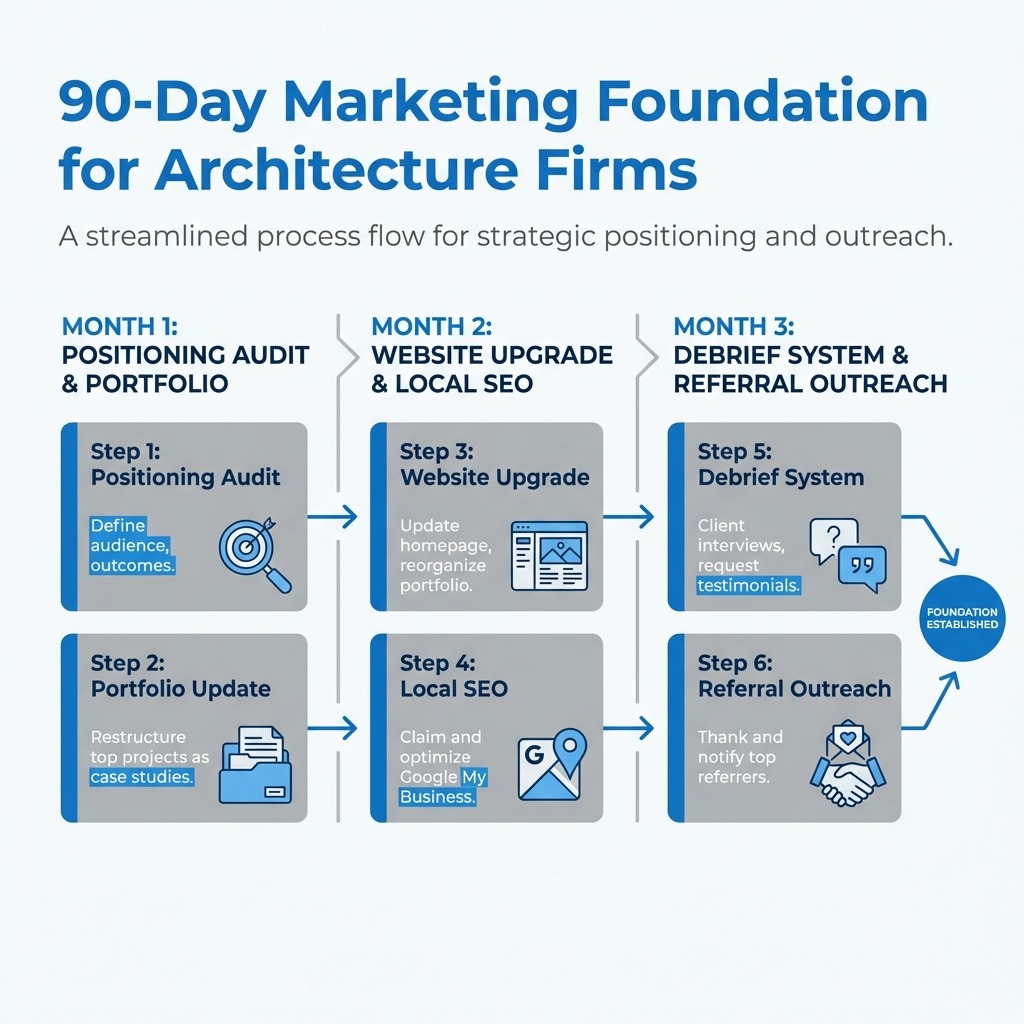
Your 90-Day Marketing Foundation Checklist
If you’re reading this and feeling the urgency of a thinning pipeline, here’s where to start.
Month One: Positioning and Portfolio Audit
Write down, in one sentence, who you serve and what specific outcome you deliver. If you can’t articulate this clearly, neither can your prospects.
Then audit your portfolio: does it demonstrate this positioning, or does it just show a variety of projects? Restructure your top ten projects as case studies with client challenges, solutions, and outcomes.
Month Two: Website and Local SEO
Update your homepage to lead with your positioning statement. Ensure your portfolio is accessible and organized by client type or project challenge.
Claim and optimize your Google My Business listing. Request reviews from three recent clients. Add location-specific content to key pages.
Month Three: Relationship Conversion Systems
Create a post-project debrief template and schedule conversations with your last three clients. Request testimonials using a simple survey.
Identify your top five referral sources and send a brief note thanking them and letting them know you’re accepting new projects in [specific area].
This isn’t comprehensive. It’s foundational. But it’s also the difference between firms that grow consistently and firms that wait for the phone to ring.
The market is expanding—growth projections show architectural services valued at USD 184.1 billion in 2025 and projected to reach USD 330.1 billion by 2033. But expansion doesn’t guarantee your firm captures a larger share. That requires the systems to be found, evaluated, and chosen when opportunities arise.
Relationships will always drive architecture work. Marketing determines whether those relationships can find you, trust you, and refer you with confidence.
About the Author